

American legal procedures can be fascinating. Here, you can try to sue almost anyone over almost anything, and only then does the court decide how much your case is really worth. I always think about those product warnings that seem completely ridiculous. If a bottle says the cap is not food, someone on the legal team probably decided it was better to spend one more sentence than explain to a judge one day why it was missing.
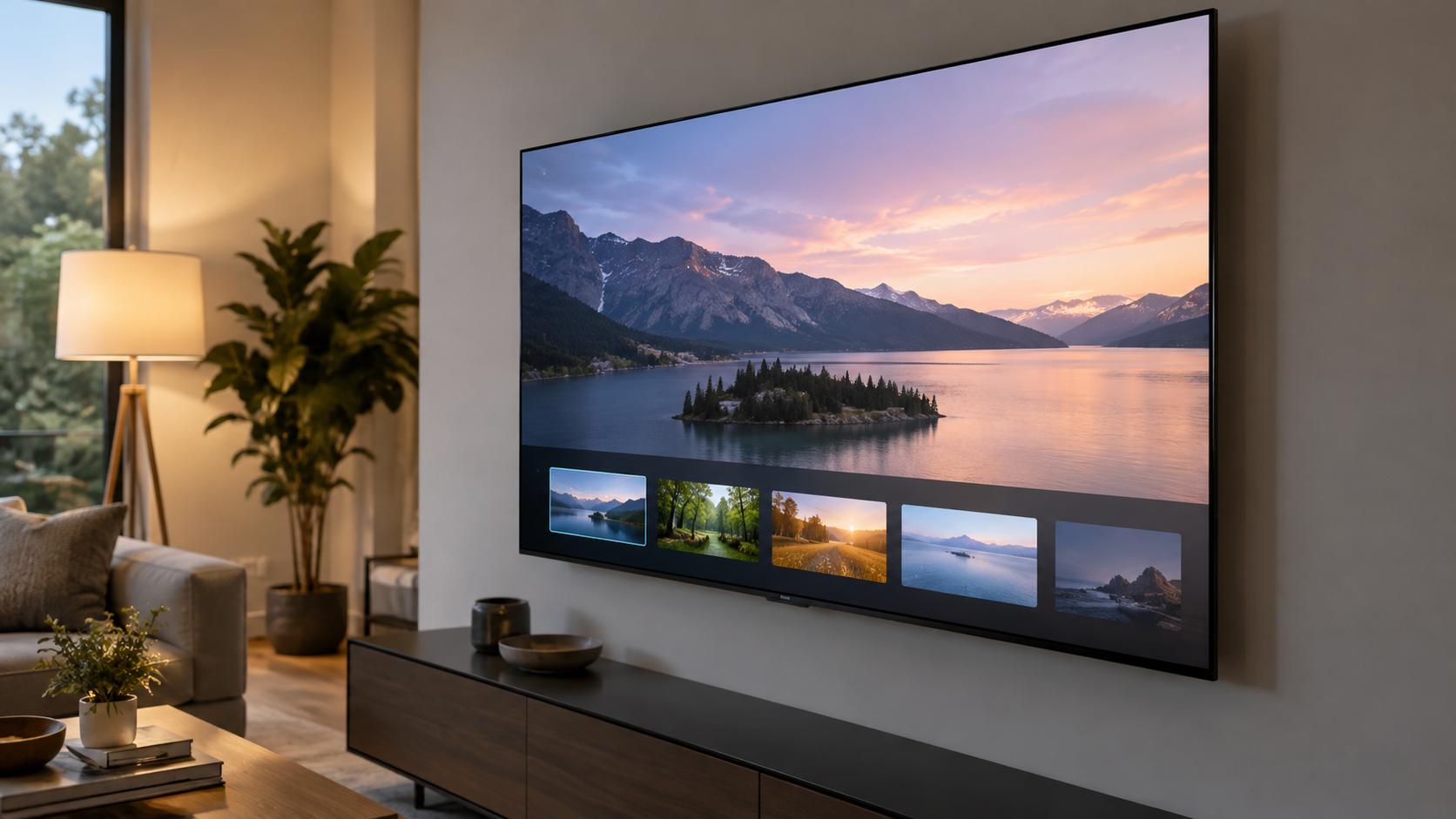
Texas says certain smart TVs can analyze screen content as often as once every 500 milliseconds, or twice per second, through Automatic Content Recognition (ACR). On December 15, 2025, the state sued five major TV manufacturers over alleged collection of viewer data without proper consent. The lawsuit named Sony, Samsung, LG, Hisense, and TCL. It also raised an important technical question: what does a television actually collect when it recognizes the content on your screen?
The story, however, became much more serious than one good headline designed to boost click-through rate. The 500-millisecond figure comes directly from the state’s allegations. It does not establish that every smart TV captures or transmits complete screenshots twice per second. The exact process depends on the manufacturer and its ACR system.
What Does ACR Actually Do Inside a TV?
I have to admit that I did not immediately know exactly what ACR does either. I knew that a smart TV could collect viewing activity data, but I did not have a clear picture of how a television technically recognizes the content that appears on the screen.
Naturally, that led me into my usual routine of opening one tab, then another, then one more.
The distinction between a digital fingerprint and a complete screenshot matters.
For example, Samsung’s explanation of ACR says its optional feature generates unique signatures that allow the collection of information about television use. The associated data may include viewing history, a television identifier, and an IP address. Samsung states that it does not record or watch the content displayed on the television.
LG offers another example. In its September 2026 privacy statement, the company explains that its ACR system uses audio fingerprints generated by the television’s internal audio processor. LG says the process does not collect screenshots or audio recordings.
LG also identifies an important technical limitation. Its ACR can recognize supported content through HDMI inputs and live television. According to the company, it does not operate inside third-party apps such as Netflix or YouTube installed through LG Apps.
That difference matters when evaluating the Texas allegations. ACR is a category of technology, and each manufacturer’s implementation deserves separate examination.
What surprised me was how broadly content recognition can work across different television sources.
Back in 2017, the FTC described a system in its case against Vizio that could identify content through cable signals and DVD players. The process also covered external streaming devices.
Vizio agreed to a $2.2 million settlement after allegations that it had collected viewing histories across 11 million televisions without adequate consumer consent. The settlement required clearer disclosures and affirmative consent.
I remember that case, but at the time I was not paying nearly as much attention to ACR. For many people, a smart TV still meant a television with a Netflix button and a few apps.
How Much Could a TV Analyze in One Hour?
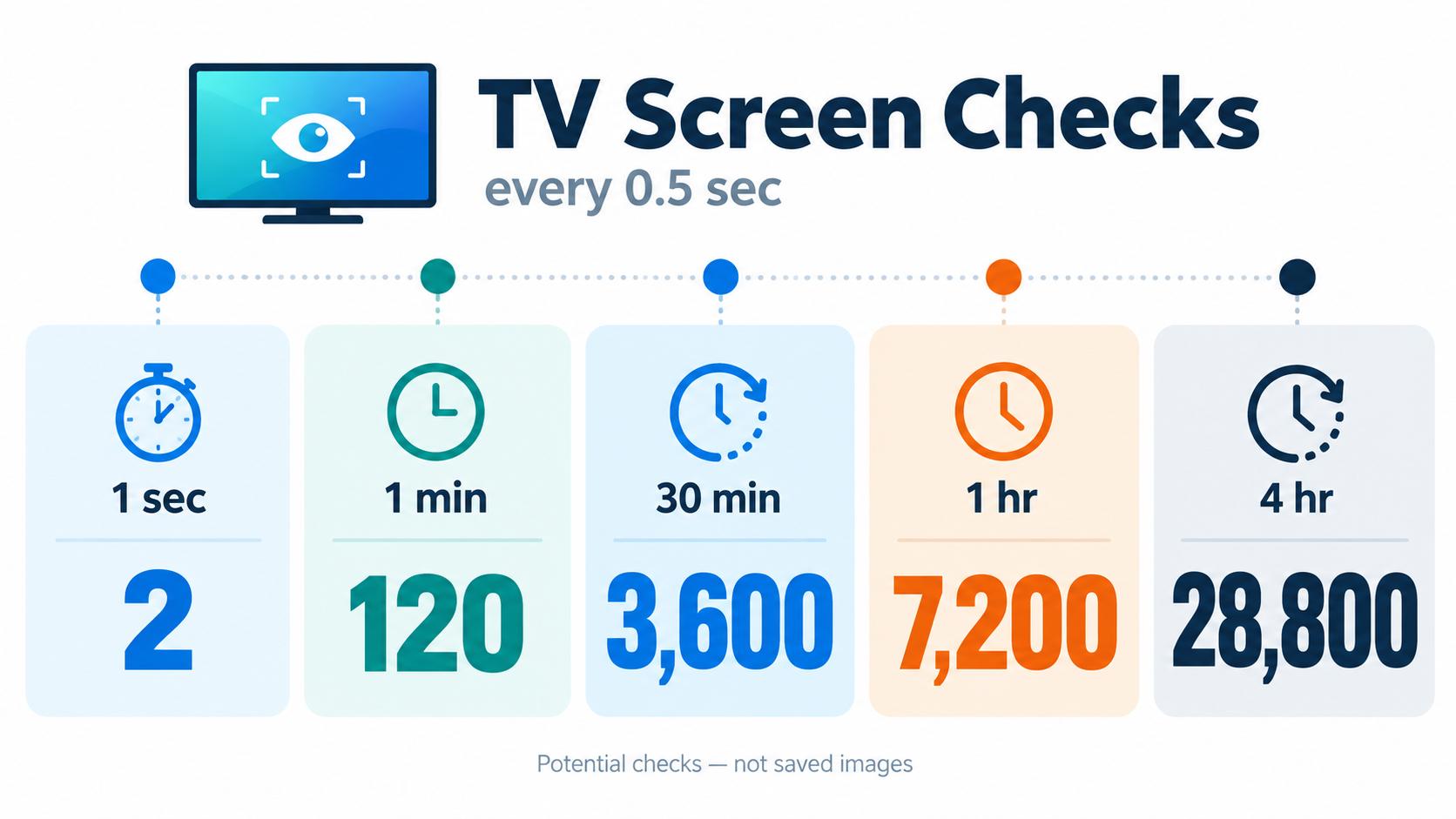
The 500-millisecond claim deserves a closer look because it creates a dramatic impression of constant surveillance.
At that interval, the mathematical frequency is easy to calculate.
| Period | Potential ACR checks at 500 ms |
| 1 second | 2 |
| 1 minute | 120 |
| 30 minutes | 3,600 |
| 1 hour | 7,200 |
| 4 hours | 28,800 |
Source: Original calculation based on the 500-millisecond interval alleged by the Texas Attorney General in December 2025.
An hour of television could theoretically involve 7,200 recognition checks at that rate.
That figure represents possible checks, not 7,200 stored screenshots or separate transmissions to a server. The calculation assumes uninterrupted operation at the stated interval. It also says nothing about how much data each check produces.
To establish actual collection volume, we would need verified information about the particular television’s software and how its ACR feature processes data.
There is another useful distinction. The number of content checks alone cannot tell us how detailed a viewer profile becomes. The content matches and their associated timestamps matter more than the raw frequency.
For example, a system that identifies the same television program repeatedly over an hour could establish a viewing session without retaining a complete image for every recognition attempt.
The privacy concern is the viewing history that can result, particularly when it becomes associated with an identifiable television or household.
Texas Saw User Consent as the Problem

When I read about the lawsuits, the frequency of the ACR checks was not even the most interesting part of the dispute to me. A much more important question is how the TV owner agreed to all of it.
According to the Texas complaint against Samsung, the state considered the manufacturer’s consent practices inadequate. Texas argued that users were presented with privacy options that failed to explain the extent of the collection clearly enough.
The concern is easy to illustrate with a familiar situation.
Imagine that you have just installed a new television. You connect it to your home network and reach a screen with several optional agreements. One option mentions personalized services, so you accept it to complete the setup.
Several weeks later, you discover that the agreement also permits collection of your viewing history.
The problem is that the original choice may have conveyed little about the actual data collection process.
That brings us back to those lawyers from the beginning of the story.
You can write a perfectly detailed ten-page privacy policy. If the average TV owner has no clear idea that accepting one option authorizes the collection of viewing history, the document alone does not resolve the consent problem. The case also illustrates a useful distinction between consent to identify content and consent to use the resulting information for advertising.
LG’s September 2026 explanation specifies that its Viewing Information Agreement controls ACR. Personalized advertising requires a separate agreement. A user could therefore permit content recognition without automatically accepting every related advertising option.
For TV owners, the important question is which individual permissions are active.
What Happened After the Lawsuits?
The legal response produced several developments.
On December 17, 2025, Texas obtained a temporary restraining order against Hisense. The order restricted the collection and use of ACR data associated with Texas residents during the legal proceedings. It also prohibited specified transfers and disclosures of that information.
Samsung subsequently reached an agreement with Texas on February 26, 2026. The agreement requires express consent before the company collects or processes ACR viewing data belonging to Texas consumers. It also calls for clearer disclosures and consent screens.
On May 11, 2026, the Attorney General announced a separate agreement with LG. LG agreed to provide a clearer explanation of its data practices and an accessible way for users to withdraw consent.
The LG agreement also includes a requirement that the company prohibit transfers of viewing data to the Chinese Communist Party. That provision forms part of Texas’s broader concerns about access to consumer information.
The agreements establish privacy commitments, but they should not be confused with a final court determination that every allegation against the manufacturers was proven.
The state’s May 11 announcement identified the cases against Sony, Hisense, and TCL as ongoing. As of October 14, 2026, I could not verify a newer official resolution for those three cases.
To me, the most useful outcome is the emphasis on a decision the TV owner can actually make. A feature becomes much easier to evaluate when the manufacturer explains what information it collects and provides a clear option to refuse.
Can You Turn Off ACR Yourself?
After the initial lawsuits, Texas published general instructions for disabling ACR on December 19, 2025. The guidance provides a reasonable place to start, although exact menu names depend on the television model and its software version.
Open the television’s Settings menu and look for Privacy, Terms & Conditions, or a similar section.
Samsung uses the name Viewing Information Services for its ACR permission. The manufacturer’s official explanation confirms that users can withdraw consent through their television settings.
LG uses Viewing Information Agreement.
For supported LG models, the manufacturer’s official support instructions direct users to Settings > Privacy & Terms > User Agreements. The company says its optional agreements can be reviewed and changed independently.
Disabling ACR does not necessarily disable personalized advertising or other forms of data collection. A television can maintain separate privacy controls for different services.
That distinction matters because users often assume that one privacy switch controls every form of information collection associated with the device.
There is also a limitation worth considering. Some optional functions may become unavailable after consent is withdrawn.
LG’s September 2026 statement explains that certain voice-related functions may depend on its Viewing Information Agreement because the television needs to identify the active content source to process specific commands.
The effects depend on the manufacturer and the services associated with the agreement.
What Do I Think About the Whole Story?
ACR as a technology is actually interesting to me. The ability to identify television content through small digital fingerprints is technically impressive.
I also think the disagreement over screenshots illustrates why precision matters. Texas has made serious allegations about consumer privacy. Manufacturers have provided their own explanations of how their systems operate. Readers deserve to know exactly which claims have been established and which remain disputed.
If a television can create a detailed history of what I watch, I want to know when I authorized that feature. I also want a clear way to withdraw permission.
For anyone who owns a smart TV, my advice is to examine the actual viewing-information agreement rather than judge the product solely by the headline. The relevant setting tells you far more about your current privacy choices than the presence of ACR technology alone.
And when all is said and done, I am still glad someone read the fine print.